Brands & RetailersJuly 23, 2026
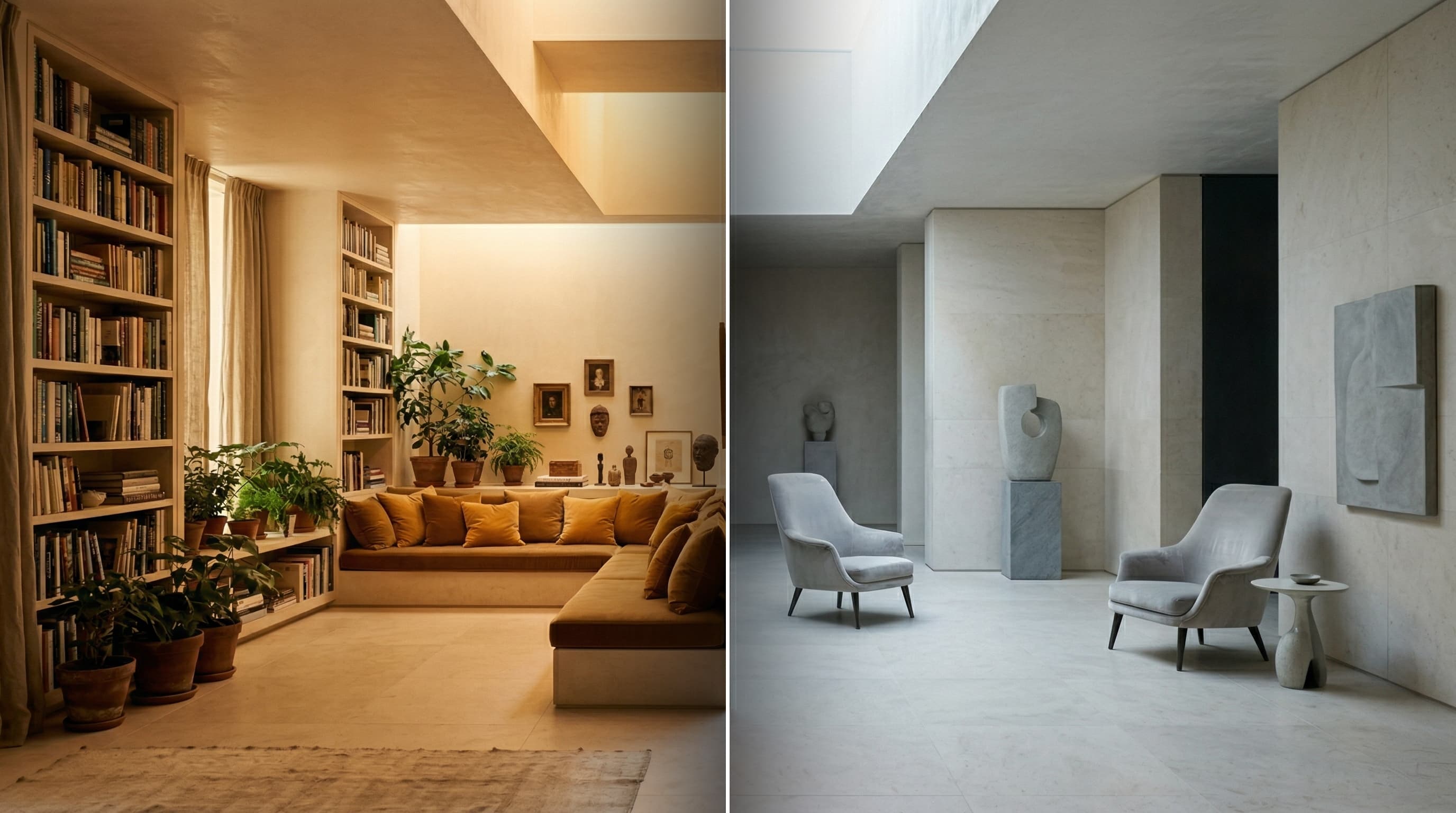
Virtual staging is a $3 billion industry built on a single guess about who the buyer is. That constraint is dissolving — and the industry hasn't caught up.
Virtual staging is a $3 billion industry built on a quiet fiction.
The fiction is this: somewhere out there is a version of your room that appeals to the most likely buyer. Find it, render it, publish it — and the right person will recognize themselves in it.
Every staged photo, physical or digital, is built on this assumption. And almost every staged photo is wrong.
The ProblemWhen a stager chooses a palette, a furniture style, a mood — they are making a guess. Sometimes it's the designer's guess. Sometimes it's the agent's. More often than not, it defaults to a genre: the "neutral contemporary" that supposedly offends no one and, consequently, moves no one either.
The problem isn't the execution. Virtual staging has become remarkably good — photorealistic, fast, affordable. The problem is upstream, in the brief. Who are we staging for? The honest answer, in most cases, is: we don't know, so we stage for nobody in particular and hope it lands.
This is a reasonable strategy when your options are limited. If you can only produce one version of a room, you'd better make it broadly appealing. But that constraint is dissolving — and the industry hasn't caught up.
The InsightHere's what's changed: you can now infer a great deal about who is likely to buy a property from the property itself.
Price point, neighborhood, architectural style, square footage, proximity to schools, walkability score — each of these is a signal. Together, they sketch a demographic. Not a perfect one, but a useful one. A $1.2M craftsman bungalow near a top-rated elementary school attracts a different buyer than a $1.2M high-floor condo three blocks from a nightlife district. We know this intuitively. We've just never operationalized it in staging.
Layer on top of that what we know about the specific visitor: how they arrived, what they've searched for, how they've engaged with other listings. A buyer who's been browsing mid-century modern homes for six months is telling you something. So is the buyer who keeps clicking on listings described as "cozy" or "character-filled."
For the first time, the data exists to move from a population-level guess to something resembling a hypothesis about this buyer, in this moment.
The ShiftThe logical conclusion of this shift is not a better single staging. It's the end of the single staging as a concept.
Imagine a listing where the living room renders differently depending on who's viewing it. The young couple relocating from a dense city sees a warm, livable space — softer furniture, bookshelves, plants, the suggestion of Sunday mornings. The empty-nesters downsizing from a larger home see something quieter and more refined — clean lines, art on the walls, a reading chair by the window. Same room, same bones, different story.
This isn't manipulation. It's relevance. Every buyer brings a life to a space — a set of habits, aesthetics, and aspirations they're hoping the home will support. Showing them a room that reflects their life back at them isn't deceptive; it's honest in a way that a generic staging never is.
The Longer ArcThere's a longer arc here worth naming.
The printed map was a remarkable technology. For centuries, it was the best tool we had for navigating the world. Then navigation became real-time, personalized, and responsive — and the printed map became a relic almost overnight, not because it was bad, but because it was static in a world that had learned to move.
The staged photograph is in a similar position. It's a static artifact in a medium that is rapidly becoming dynamic. It captures one moment, one aesthetic choice, one guess — and it asks every buyer, regardless of who they are, to project themselves into it.
That's a significant cognitive ask. Some buyers can do it. Many can't. And the ones who can't move on to the next listing.
As AI-generated visualization becomes faster, cheaper, and more integrated into the listing experience, the idea of publishing a single staged image will start to look like an unnecessary constraint — the equivalent of printing one map and hoping everyone's going to the same place.
What This MeansThe transition won't happen all at once. Static staged images will be around for a long time, just as printed maps still exist. But the competitive advantage is shifting.
Agents who understand that staging is fundamentally a communication problem — how do I help this buyer see themselves here — will be better positioned than those who treat it as an aesthetic problem. Platforms that can generate personalized room visualizations at scale will become infrastructure, not novelty.
And the $3 billion guess will start to look like what it always was: a best effort under constraints that no longer apply.